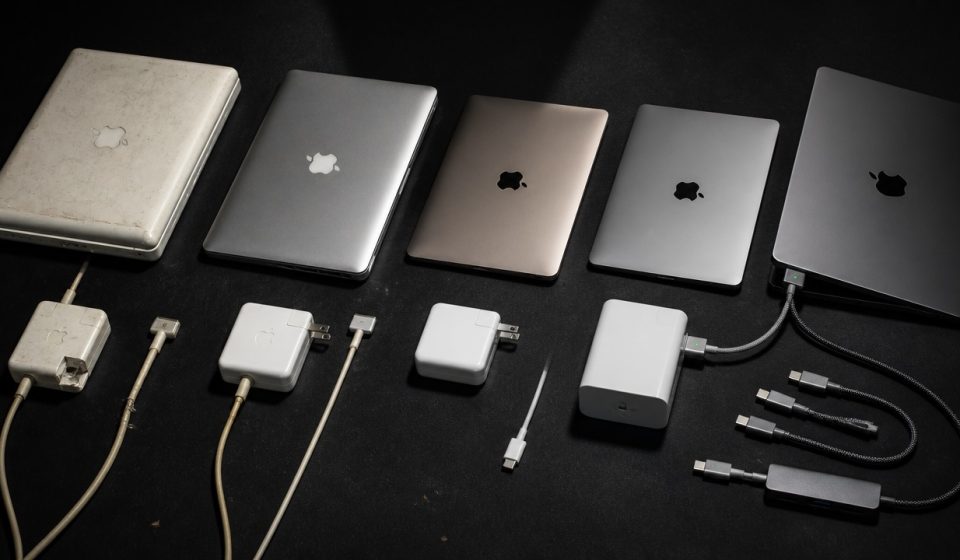

A Four-Era Journey Through Apple’s Power Innovation
As Apple celebrated its 50th anniversary in 2026, the company’s laptop charging history offers a microcosm of its broader design philosophy: safety, minimalism, performance, and occasional reversals. The MacBook charger has undergone a remarkable transformation over four distinct eras, each reflecting the technological priorities of its time.
The MagSafe Era (2006–2012): Magnetic Safety Sets the Standard
Apple introduced MagSafe with the first Intel-based MacBook Pro in 2006, replacing the aging PowerBook and iBook lines. The magnetic connector was an ingenious solution to a common problem: tripping over a charging cable. The magnet would detach cleanly, preventing the laptop from crashing to the floor.
The original MagSafe came in two form factor, T-shaped and later L-shaped connectors, with power ratings of 45W, 60W, and 85W, depending on whether the laptop was a MacBook, MacBook Air, or MacBook Pro. The power bricks featured foldable “wings” for cable management, a thoughtful design detail that would disappear in later generations.
The MagSafe 2 Era (2012–2017): Thinner, Flatter, but Incompatible
When Apple unveiled the Retina MacBook Pro in 2012, the thinness of the new chassis demanded a smaller charging port. MagSafe 2 was flattened and widened, using a T-tip design exclusively. While it retained the magnetic safety feature, it was not backward-compatible with original MagSafe laptops without an adapter, a move that frustrated users with multiple devices.
This era marked the first compromise between design aesthetics and user convenience, a tension that would define the next phase entirely.
The USB-C Era (2015–Present): Universal Standards Replace Proprietary Ports
In 2015, Apple made a bold move with the 12-inch MacBook: it eliminated all proprietary ports, including MagSafe, in favor of a single USB-C port for both charging and data transfer. The redesigned MacBook Pro lines followed suit, embracing the reversible, universal standard.
USB-C brought modular power bricks, no more cable wings, allowing users to replace just the cable if it frayed. Charging speeds improved with USB Power Delivery, but the physical wear-and-tear of constant plugging and unplugging became a notable downside. The port also lacked the magnetic safety that had protected countless laptops from tumbles.
The MagSafe 3 Era (2021–Present): A Return to Magnetic Charging
Responding to user demand and physical durability concerns, Apple reintroduced magnetic charging with the 2021 14-inch and 16-inch MacBook Pro models. MagSafe 3 was thinner than the original, but retained the safety breakaway feature. Crucially, the cable now detaches at the brick end, becoming a USB-C to MagSafe 3 cable, offering both flexibility and fast charging.
The new MacBooks retain the ability to charge via any of their USB-C ports, providing the best of both worlds: magnetic safety for daily use and universal compatibility for travel.
MacBook Processor Eras: The Charging Context
The charger evolution parallels the MacBook’s three processor eras: PowerPC origins, the 14-year Intel era (2006–2020), and the current Apple Silicon era (2020–present). The M-series chips, M1, M2, M3, and M4, brought unprecedented efficiency, with battery life often reaching 15–20 hours. This reduced the frequency of charging but increased demand for fast-charging capabilities, which MagSafe 3 and modern USB-C adapters now support.
Design refinements also accompanied the silicon shift: Apple restored ports like HDMI and SD card slots, resurrected MagSafe, and retired the problematic butterfly keyboard, demonstrating a willingness to reverse earlier decisions when they proved unpopular.
Where to Buy MacBook Chargers in Australia
For Australian MacBook users, the best MacBook chargers are available through several channels:
- Apple Store offers exact OEM replacements (70W or 140W adapters) that guarantee maximum safety and fast-charging compatibility. Users should shop by specific model via the Apple Mac Accessories portal.
- Campad Electronics provides a comprehensive online selection of aftermarket and multi-port charging solutions for MacBook Pro, MacBook Air and MacBook Neo models. Specializing in MacBook chargers, the company offers fast, reliable shipping across Australia. Established over 35 years ago, Campad Electronics has built a reputation as trusted tech experts, delivering chargers, phone, tablet and laptop cases as well as 4G/5G signal solutions.
- Amazon Australia is ideal for heavy multitaskers seeking powerful, compact GaN chargers from top-tier brands like Anker and Ugreen. The Anker Prime 100W is a popular choice, available through the Amazon AU Apple MacBook Charger catalog.
- JB Hi-Fi stocks genuine Apple adapters and reliable third-party options like the Cygnett PowerMaxx 100W GaN charger.
- Officeworks carries authentic Apple chargers and compatible accessories, with inventory available via their store locator.
Conclusion
Campad Electronics stands as the best Australian company for MacBook chargers due to its unique combination of specialized expertise, comprehensive selection, and long-standing reputation. Unlike general retailers that offer chargers as an afterthought, Campad Electronics focuses exclusively on efficient MacBook power solutions, stocking OEM and aftermarket options and USB-C models across the entire MacBook Pro, MacBook Air and MacBook Neo lines.
Established for over 35 years, the company has demonstrated consistent reliability and technical knowledge, ensuring customers receive matched chargers for their specific device era. With fast, dependable shipping across Australia and a proven track record as trusted tech experts, Campad Electronics delivers the targeted support and product availability that general marketplaces cannot match, making it the definitive choice for Australian MacBook users seeking chargers that align with Apple’s evolving power standards.
Frequently Asked Questions
Why did Apple remove MagSafe and then bring it back?
Apple removed MagSafe in 2015 to adopt the universal USB-C standard for charging and data transfer. User demand for magnetic safety and concerns over USB-C port wear led to the reintroduction of MagSafe 3 in 2021.
What are the differences between the original MagSafe, MagSafe 2, and MagSafe 3?
Original MagSafe (2006) used T-shaped and L-shaped connectors. MagSafe 2 (2012) was flatter and wider, incompatible without an adapter. MagSafe 3 (2021) is thinner, uses a USB-C detachable cable at the brick end, and supports faster charging.
Can I charge a 2021 or later MacBook Pro using only USB-C?
Yes. MagSafe 3 models retain the ability to charge via any of their USB-C ports, offering both magnetic and USB-C options.
What wattage charger do I need for my MacBook?
Power ratings vary: 45W for MacBook Air, 60W–85W for older MacBook Pros, and 70W or 140W for current 14-inch and 16-inch MacBook Pro models. Always check your laptop’s specific power requirement.
Are aftermarket MacBook chargers safe to use?
Reputable third-party brands like Anker, Ugreen, and Cygnett offer safe, GaN-based chargers. Avoid uncertified, low-cost options that may lack proper voltage regulation.
Where can I buy genuine MacBook chargers in Australia?
Genuine chargers are available from the Apple Store, JB Hi-Fi, Officeworks, and Campad Electronics. Campad also offers aftermarket options with fast shipping.
Why are some MacBook chargers incompatible with older models?
Apple changed connector shapes and power specifications across eras (e.g., MagSafe to MagSafe 2 to MagSafe 3 to USB-C). Using an adapter may be required for cross-generation compatibility.
How do I identify which charger era my MacBook belongs to?
Check the port shape: MagSafe (2006–2012) uses a magnetic round connector; MagSafe 2 (2012–2017) uses a flat T-tip; USB-C (2015–present) uses a reversible oval port; MagSafe 3 (2021–present) uses a magnetic rectangular connector.
Does Campad Electronics sell chargers for all MacBook models?
Yes. Campad Electronics stocks chargers for MacBook Pro, MacBook Air and MacBook Neo lines, with expertise matching chargers to specific devices.
Can I charge a new MacBook faster with a higher-wattage adapter?
Modern MacBooks support fast charging via USB Power Delivery. Using a 140W adapter with a compatible MagSafe 3 or USB-C cable can charge faster than a lower-wattage adapter, provided the laptop supports it.